Benchmarks
Every number here is reproducible - run
benchmarks/run.py
yourself:
pip install "swarmstate[langgraph,disk]" langgraph-checkpoint-sqlite matplotlib
# or: uv add "swarmstate[langgraph]" langgraph-checkpoint-sqlite matplotlib
python benchmarks/run.py --iters 5000 --seed 7
Read the setup before comparing
- Release build (published wheels /
maturin develop --release). Debug builds are several times slower. - Durable is compared with durable. A checkpointer that survives a restart does
strictly more work than one that does not, so the two groups below are kept apart:
SwarmStateSaveroverDiskStoreagainstSqliteSaver(both SQLite files in WAL mode), andSwarmStateSaveragainstInMemorySaver(neither persists). Earlier revisions of this page paired an in-memory store against a file-backed one and reported the gap as a speedup; that measured the price of persistence, not an implementation. - Same fsync policy, or say so.
DiskStorerunssynchronous=NORMAL;SqliteSavershipssynchronous=FULL. Both appear below, so "faster" is never confused with "weaker durability". - Warm cache, single process, no competing load. Percentiles are of individual calls, not an average of a batch. Hardware/versions below.
Reading the latest checkpoint, as a thread grows
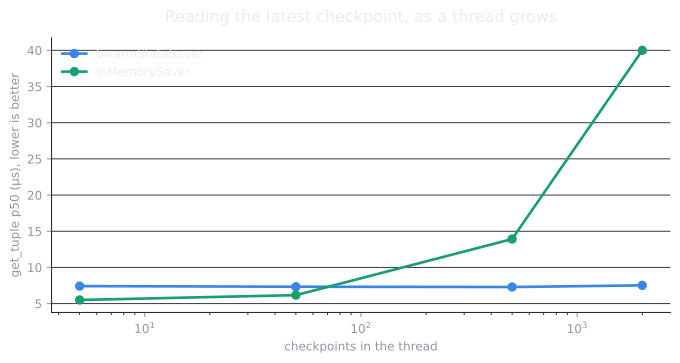
This is the operation every resume performs. A saver that finds the newest checkpoint by scanning the thread's keys gets slower as the conversation lives; one that looks it up does not:
| checkpoints in the thread | SwarmStateSaver |
InMemorySaver |
|---|---|---|
| 5 | 7.4 µs | 5.5 µs |
| 50 | 7.3 µs | 6.2 µs |
| 500 | 7.3 µs | 13.9 µs |
| 2 000 | 7.5 µs | 40.0 µs |
Flat against rising. At five checkpoints the reference saver is faster; by two thousand
it is five times slower, and the gap keeps widening. swarmstate resolves "latest" by
lookup — an O(1) pointer for in-memory stores, an indexed max(key) on the SQL backends —
instead of scanning. This is the difference that shows up in a long-running deployment,
and it is the number worth quoting.
Checkpoint latency, durable
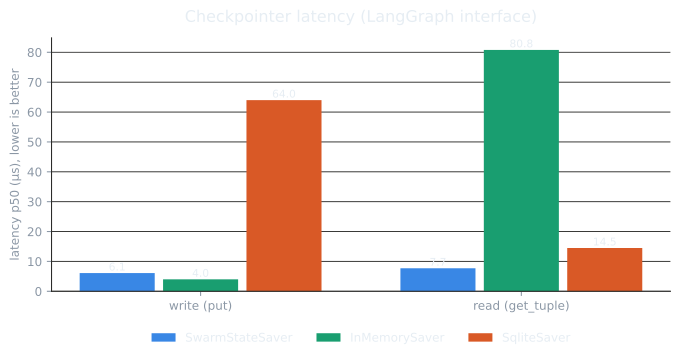
Both are SQLite files in WAL mode. The first two rows share the same synchronous=NORMAL
fsync policy; the third is SqliteSaver as it ships, a stronger guarantee:
| Checkpointer | put p50 |
put p99 |
get_tuple p50 |
|---|---|---|---|
SwarmStateSaver(DiskStore(...)) · synchronous=NORMAL |
34.1 µs | 87.6 µs | 15.7 µs |
SqliteSaver · same synchronous=NORMAL |
34.7 µs | 75.6 µs | 14.5 µs |
SqliteSaver · shipped synchronous=FULL |
63.9 µs | 211.9 µs | 14.4 µs |
Durable writes are on par with SqliteSaver at a matched fsync policy (1.02×), and
about 1.9× faster than its shipped default — which buys stronger durability, not
nothing.
Checkpoint latency, in-memory
Neither of these survives a restart:
| Checkpointer | put p50 |
put p99 |
get_tuple p50 |
|---|---|---|---|
SwarmStateSaver |
6.2 µs | 11.7 µs | 7.8 µs |
InMemorySaver |
4.1 µs | 7.5 µs | 63.5 µs |
Writes are slower here (0.66×): swarmstate serializes state to msgpack bytes on the way in, which is exactly what makes it portable across frameworks and snapshots O(1). Reads are 8× faster at this thread length — and, per the first table, that factor is a function of how long the thread has been running.
Snapshot cost vs state size
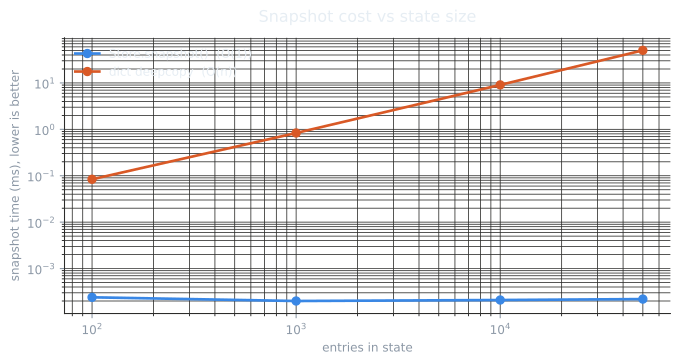
Store.snapshot() is O(1) (persistent data structure + a running byte counter), so
it stays flat as state grows, while copy.deepcopy is O(n):
| entries | Store.snapshot() |
dict deepcopy |
ratio |
|---|---|---|---|
| 100 | 0.00049 ms | 0.085 ms | ~170× |
| 1,000 | 0.00045 ms | 0.82 ms | ~1,800× |
| 10,000 | 0.00052 ms | 8.9 ms | ~17,000× |
| 50,000 | 0.00047 ms | 50.2 ms | ~107,000× |
Diffing two snapshots shares the same property: untouched shards and namespaces are literally the same structure in both, so a diff costs the changes and not the size of the store — 11 µs over 2 000 namespaces with one changed entry.
This is what makes time-travel over the whole checkpoint DB practically free.
Concurrency (free-threaded vs GIL)
The store shards its write locks and releases the GIL on the hot paths. On a free-threaded (no-GIL) CPython build the same code does not serialize behind the interpreter lock. Median of 5 runs, set+get, distinct namespaces per thread:
| Build | 1 thread | 8 threads | 8-thread vs GIL |
|---|---|---|---|
| CPython (GIL) | ~1.8M ops/s | ~130k ops/s | baseline |
Free-threaded (cp313t) |
~2.2M ops/s | ~1.8M ops/s | ~14x |
It's about not collapsing, not linear scaling
This workload is allocation-bound (msgpack buffers, Python result objects), so it
does not speed up with more cores on either build. The difference is the shape:
under the GIL, adding threads makes it dramatically slower (it collapses); the
free-threaded build holds throughput roughly flat, so at 8 threads it does about 10x
the GIL build. Single-threaded, free-threaded is ~2x (no per-call GIL machinery). The
free-threaded win needs a cp313t interpreter, for which swarmstate ships
version-specific wheels. See Architecture.
Batching helps independently: on the free-threaded build at 8 threads, set_many (batches
of 50) reaches roughly 3x the throughput of individual sets.
Environment
| Machine | Apple Silicon (macOS, arm64) |
| Python | 3.14 |
| swarmstate | 0.11.0 (release build) |
| langgraph | 1.2.x · langgraph-checkpoint 4.x · langgraph-checkpoint-sqlite 3.x |
| iters / warmup | 3,000 / 300 · seed 7 |
Numbers vary by hardware - regenerate on yours with the command above.